
How to Choose the Right CRM for Your Business (A Practical Guide for 2026)
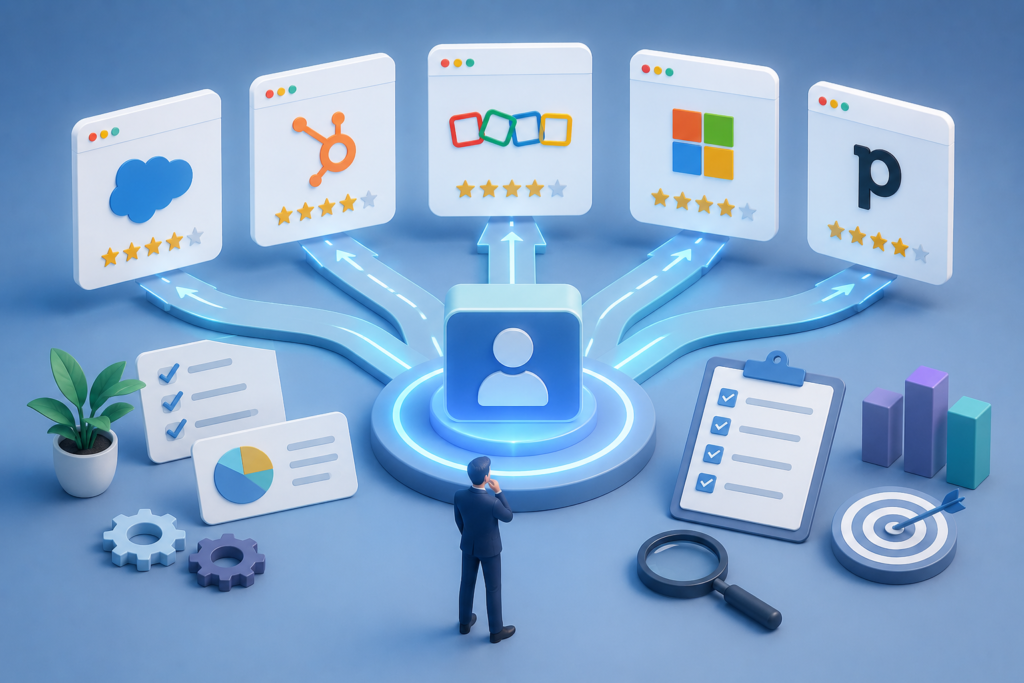
Choosing a CRM shouldn’t feel complicated.
But for most businesses, it does.
You start comparing options like Salesforce, HubSpot, and Zoho. You read feature lists, watch demos, and maybe even talk to vendors — yet the decision still feels unclear.
And that’s where most businesses go wrong.
Not because they lack options, but because they approach the decision from the wrong angle.
The best CRM is not the one with the most features.
It’s the one that fits your business the way it actually works.
In this guide, we’ll walk you through how to choose the right CRM — based on real-world implementation experience — so you don’t end up with a system your team avoids using.
Why Choosing the Right CRM Matters More Than You Think
A CRM is not just a tool you install and forget.
It becomes the foundation of how your business tracks leads, manages relationships, and makes revenue decisions.
When the CRM is right, everything feels smoother:
- Your sales team knows what to do next
- Your pipeline becomes clear
- Your data becomes reliable
But when it’s wrong, the impact is silent — and expensive.
You’ll start noticing things like missed follow-ups, inaccurate reports, and teams working outside the system. Over time, this leads to poor decisions and lost opportunities.
That’s why choosing the right CRM is less about software — and more about setting up your business for scale.
Start With Your Business- Not the CRM
Before you look at any platform, take a step back.
Ask yourself:
What exactly are we trying to fix?
In most cases, the answer isn’t “we need Salesforce” or “we need HubSpot.”
It’s something deeper:
- Leads are not tracked properly
- Sales processes are inconsistent
- Reporting is unclear
- Follow-ups are manual and unreliable
If you don’t define this clearly, even the best CRM will fail.
Because the problem was never the tool — it was the lack of clarity.
Quick Tip
If you’re currently evaluating CRMs and feel overwhelmed, it’s often helpful to map your sales process first.That alone solves 50% of the confusion.
Understanding Which CRM Fits Your Growth Stage
Not every CRM is built for every business.
The right choice depends heavily on where you are today — not where you think you should be.
Early-stage teams usually need something simple and fast. Tools like HubSpot or Zoho work well here because they are easy to set up and don’t require heavy customization.
As your business grows, your needs change. You may need better reporting, automation, and control over your processes. At this stage, both HubSpot and Salesforce can work — depending on how complex your workflows are.
For scaling organizations with multiple teams, advanced processes, and deeper customization needs, Salesforce becomes a strong option. But it also requires proper planning and ownership.
The mistake many companies make is choosing too early for where they want to be, instead of where they are today.
Salesforce vs HubSpot vs Zoho — How to Think About It
Instead of asking which CRM is “best,” ask which one aligns with your needs.
Salesforce is powerful and flexible. It’s ideal if you need deep customization and scalability. But without proper setup, it can quickly become complex and difficult to manage.
HubSpot is known for its simplicity and ease of use. It works well for teams that want quick adoption and alignment between marketing and sales. However, it may feel limiting as complexity increases.
Zoho offers a cost-effective and flexible solution, especially for small to mid-sized teams. It provides a solid feature set but may require more effort in structuring and usability.
Each tool has its place.
The real challenge is choosing based on your business — not the brand name.
What Actually Matters When Choosing a CRM
Most businesses get distracted by features.
But in reality, a few key factors determine whether your CRM will succeed or fail.
The first is usability. If your team finds the system difficult, they won’t use it consistently. And without consistent usage, even the best CRM becomes useless.
The second is how well the CRM matches your process. You don’t need a highly customized system on day one. In fact, overengineering early is one of the biggest mistakes companies make.
Automation is another important factor — but only when it simplifies work. Good automation reduces manual effort without making the system harder to manage.
Then comes visibility. Your CRM should give you clear insights into your pipeline, not overwhelm you with reports no one understands.
Finally, consider the total cost — not just the subscription. Implementation, customization, and ongoing maintenance often matter more than the license itself.
Common Mistakes Businesses Make (And How to Avoid Them)
One of the most common mistakes is choosing a CRM based purely on features.
More features don’t mean better results. In many cases, they create more confusion.
Another mistake is trying to build a perfect system from day one. The best approach is to start simple, ensure adoption, and improve over time.
Many companies also underestimate the importance of ownership. A CRM without a clear owner internally will slowly lose structure and reliability.
And perhaps the biggest mistake of all — poor implementation.
Even the best CRM can fail if it’s not set up properly.
A Simple Way to Make the Right Decision
If you’re still unsure, simplify your approach.
Focus on:
- What problem you’re solving
- What your team actually needs today
- How easy the system will be to use
- How it will scale with you
You don’t need the perfect CRM.You need the right starting point.
Many businesses reach this stage and struggle to make a confident decision.
At Sietrix Technology, we help companies:
- Evaluate the right CRM based on their business
- Avoid costly implementation mistakes
- Build systems that actually get used
If you want a second opinion before making a decision, feel free to reach out for a quick consultation.
Final Thoughts
Choosing a CRM is not about picking a tool.
It’s about building a system that supports how your business grows.
Because at the end of the day:The CRM doesn’t drive results.
The way you implement and use it does.
Want to Go One Step Further?
We’ve created a simple CRM Selection Checklist that helps you evaluate the right platform step by step.
If you’d like a copy, just reach out — we’ll share it with you.